16 June 2013

Review: After Earth

(Dir: M. Night Shyamalan, 2013)  

I'm going to begin this review with a related two part question. i) What the hell is Will Smith doing with his career? Returning to acting after a four year break with last year's Men In Black III was probably wise, if completely uninspired, and following that up with the title role in Django Unchained would've been just what he needed, but instead he left that project for the not exactly inspired After Earth. ii) What the hell happened to M. Night Shyamalan? After appearing out of nowhere to wide acclaim with both The Sixth Sense and Unbreakable, but falling to unfair criticism for some intriguing films (I'm thinking The Village and Lady In the Water), Shyamalan seems to have gotten lost down an increasingly mundane rabbit hole somewhere, whilst running further from his strengths by adapting The Last Airbender and making After Earth. Sadly it seems he actually listened to the critics and lost faith in himself.

Like the recent Oblivion (review here), After Earth is another original big budget science fiction movie, something we continue to need but which worryingly seems a perilous business decision when confronted with such poor box office. Set a thousand years in the future, Earth is but a distant memory for mankind thanks to our predilection for destruction. Inhabiting a new planet / solar system means a different type of life and threats, the greatest being Ursa's, a creature who relies on the fear of its prey in order to hunt and kill. Will Smith plays Cypher Raige (yes, seriously) a revered General capable of never showing fear, who with his keen to impress son Kitai (Jaden Smith), crash land on a quarantined Earth with an Ursa and must fight to survive on this now alien landscape. 

 
After Earth is actually a far simpler film than that description makes it sound. After a short set up we're quickly intruding on a lush green Earth, and bar a few flashbacks it evolves into the Smith's show. Jaden becomes the lead trekking through the wild with a destination that must be reached, as Will is confined to the ship's wreckage, but as this is the future communicating with each is of course not an issue. The futuristic set-up that's been established seems almost perfunctory, it only really adds intrigue to some of the Earth bound scenes via the 3D digital displays in the ship, or Kitai's smart suit and the cutlass he gets to use. As you'd imagine some of the nature based cinematography is fantastic, but likewise there are other scenes, such as the senior Smith trying to calm his son as the ship comes down to Earth, that also work well. But then After Earth overdoes it on the CGI animal front, with some just not looking convincing and seriously detracting on the threat we should feel. 
 
Jaden is only fairly capable in the lead, lacking the personality that let him carry The Karate Kid. For a large portion of the film he veers closer to irritating, and it's only as we're into the second half that being in his presence ceases to be such a chore. The (clichéd) emotional weight he's carrying certainly doesn't help. If this is supposed to be the film to convince that he should be a leading actor, it's not successful. Yet amazingly Will fares a lot worse, hence my concern at the outset of this review. His role as the emotionless, stoic general is entirely one-note, as he treats his son like someone in his command. It's frustrating to watch as we know this character should be so much better as it's Will Smith on the screen, but there's just nothing there. The slivers of emotion that they try to interject get lost. The only notion of a familial connection between the two is physically, and as the story relies on the whole father / son aspect to work, this is something of a major failing. 

As films about trekking through the wilderness go, After Earth is vaguely interesting mostly because of the futuristic spin, but it never gets particularly exciting or does anything original. As it progresses it does become more enjoyable, which mostly seems due to the lack of significance Smith Sr plays in proceedings. But all in all it's an average film that falls apart from the emotional angle. In terms of Shyamalan's involvement, that's indiscernable - much like The Last Airbender this could've been directed by anyone as there's no personality or essence of passion to it. I really hope he goes back to writing and directing something akin to his earlier work as we need more creative minds like his in the industry. But the biggest irony of all; this is based on a story by Smith and yet this is one of the worst roles of his career. Go figure.

2 June 2013

Review: The Purge

(Dir: James DeMonaco, 2013) 

The Purge is a film full of interesting ideas even if it has a number of issues in execution. The premise itself is fascinating; in the near future in a vastly "improved" American society and economy, citizens are allowed an annual twelve hour period in which they can purge themselves of the anger and frustration that's been building up over the past twelve months in any way they please. There are no laws and no emergency services. Everything illegal is permitted. An intriguing idea but something with a lot more depth than at first glance.

The first thought is what does it take for society to get to the point where murder and other crime is briefly legal and almost encouraged by the government. No actual details are given about the "new founding fathers" and what actually took place to start this, it kind of doesn't matter to the immediate story in the film, but how do you get a country to 1% unemployment and where does this acceptable attitude to violence come from? Humanity itself is of course extremely violent by nature but this also suggests there is something more ingrained within this culture. I was reminded of The Running Man, where society regressed to watching humans killed for entertainment like in Roman times. This is just an extension of that.

 
On the next level down it becomes an issue of class warfare. The rich and privileged feel it's their duty during this short window to hunt down and kill the poor who aren't contributing to society. It's likely a deep seated feeling in culture that here is given its "acceptable" outlet. It doesn't matter who these people are, even if they are struggling military veterans for example, it's simply that they're perceived to be doing nothing to justify their right to exist. But this also goes the other way, as an opportunity for those who are doing even better than you to be punished for daring to be more successful. The irony being that for a society built on capitalism and embracing personal success, some highly achieving people still can't deal with others doing just that bit better and will take the opportunity to exercise pain on them.

With all these intriguing ideas on hand it's disappointing that The Purge doesn't totally deliver, resulting in something of a bog standard home invasion thriller. Not that this is bad as it is entertaining, but the story of the Sandin family (Ethan Hawke, Lena Headey, Max Burkholder & Adelaide Kane) trying to defend their large locked down home on this fateful night, and put into a position of deep ethical dilemma, feels wanting for more. The characters are all likeable enough but after a fairly slow start it ends up a pretty standard action thriller about fighting for survival, with enough scenes of slightly creepy darkened corridors and the tease of masked maniacs on a killing spree hidden around the corner. These masks are faintly unnerving, but most notable is the face of our chief antagonist (Rhys Wakefield), who unmasked has the most sinisterly polite smile. This works but without being scary, which is maybe something that would've helped. 

The Purge has the potential to be so much better than it actually is. As a generic home invasion film it's entertaining enough without breaking new ground, but the core concept and ideas layered within are really fascinating, offering much to think about. They just deserve more from the film they're in. Nonetheless there's a lot more that could be done with this concept in future films by focusing on other people / participants, and that's something I'd like to see. 

1 June 2013

Review: Fast & Furious 6

(Dir: Justin Lin, 2013)

Against all odds the Fast & Furious franchise is now proving to be the modern action movie model that all others should be aspiring too. Quite how it came to this is still something of a mystery, considering a pretty decent first movie and a handful of extremely lacklustre sequels, but the fifth film was a hugely entertaining and satisfying revelation in comparison, surprisingly so! We certainly have the return of the original key characters, as well as throwing in a couple of characters from the sequels, to thank for making this so successful; the filmmakers have created a sort of family that we clearly want to be continually welcomed into.

But that's not just it, there's another sizeable reason why these films are now working - Dwayne "The Rock" Johnson. His initial presence in the last film as special agent Hobbs, which he reprises in this sixth film, is inspired casting and a great way to add something to the series. Last film we wanted to see him fight Vin Diesel, however there's a nice change where he's gone from foe to reluctant teammate of the Toretto crew. Johnson just makes every film he's in better. He has the personality and the sheer presence, regardless of his acting ability, and there's no difference here - I'm a fan of the "Sumerian Thor" and this series is all the better because he's now part of it.

 
If you watched the fifth film it'll rapidly become evident not to expect anything different in part six, except it's all amped up to the next level here. The story is functional but does the job of (forgive the pun) driving the story forward. There's a bad guy to catch but notably the one key cast member who didn't return in the last film, Letty (Michelle Rodriguez), has risen from the dead and is on the side of villain Shaw (Luke Evans) and thus there's a little more intrigue aside from just stopping him.

But let's be honest, although the family side is important, how much do we care about all this when there's exotic sports cars to be raced, all manner of things to be blown up and insanely ridiculous stunts to amaze us with. It's hard to fault any of this because it delivers with confidence. These films know what they are so push it to the limit, which is why watching a tank chasing some classic modified sports cars down a sunny highway makes perfect sense, and if you think not then you're watching the wrong film. And even better that much of this is done using practical effects rather than relying on CGI.

Expectedly Fast & Furious 6 is a hell of a lot of fun. It's difficult to actually complain about any of the ridiculousness because that's the point, so it's best to just embrace it and check your brain at the door. However as someone who lives in London, seeing the film mostly set in the city was somewhat distracting and less exciting than the sunny exoticness of Rio in the last film. But that's just a random personal complaint. The rest just picks up where part five left over and gives us more Rock and throws in Michelle Rodriguez and Gina Carano too. I didn't really expect anything more so job happily done. And if the only purpose of the scene during the end credits is to create excitement for the next film then consider me excited!

28 May 2013

Review: The Hangover Part III

(Dir: Todd Phillips, 2013)

To say The Hangover Part III had it's work cut out for it would be something of an understatement. It's left sitting in an awkward position of not wanting to do the same thing as the first two films whereas trying to do something different is a risky strategy. Part II's major failing was that it was the exact same plot transplanted from Vegas to Bangkok, with identical story beats and "comedic" moments. This lack of originality rendered it entirely predictable and the humour forced. It was the perfect example of how not to do a sequel and a massive unfunny failure (except of course at the box office where it reaped massive amounts of money). The first film wasn't perfect but it felt like a fresh comedy with an approach that was genuinely intriguing whilst leveraging some great comedic moments.

Part III (wisely) takes the different approach. There are no hangovers or blacked out moments that need re-piecing together, instead it's a through story tenuously linking back to the first film, that tries to give us as much of Leslie Chow (Ken Jeong) as possible and offers new threat in the form of John Goodman's crime boss Marshall, who forces the Wolfpack into a new range of wild situations.

Although it was probably the right decision to push the story off in another direction, the chosen route doesn't really work. In fact it's quite hard work, going for bland thrills and action. The set-up that gets the group on the road makes sense, yet it's pretty boring and the story continues in this dull manner all the way until it hits Vegas somewhere after the halfway point, where it shows small glimmers of life. But only small glimmers. Vegas is where the heart of the series lies, but this ends up as yet another pale pale reminder of the first film.


Part of the problem lies with the characters. Man-child Alan (Zach Galifianakis) is more annoying than ever, and his schtick already feels done to death with Galifianakis playing variations of this character in both Due Date and The Campaign. Alan is a thin character who's finally stretched beyond breaking point in this third film. The others have become even more generic with only Bradley Cooper seemingly coming out unscathed by virtue of being the least annoying. Yes there's something vaguely comfortable about being in their presence but it's a rapidly diminishing notion. Chow's screeching mania is funny in small doses and as such worked in the original film, but has been totally over-used since then rendering it impotent.

And this is the big problem - both Alan and Chow are supposed to be the primary comic relief and the pair are rarely funny here. I managed a handful of mild chuckles throughout, but there were only two proper genuine laughs in the film, and one came in the scene during the end credits rather than the actual film! What Part III is not is funny. It's just dull blandness. The irony about the aforementioned end credit scene is that it cruelly rubs the potential for a better film in our face.

Two sequels in and it's clear The Hangover was lightning in a bottle, being that rare comedy that's genuinely funny, surprising and entertaining. But these sequels have done their best to shatter that bottle rather than preserve what it contained. Part III barely registers on the comedy scale whilst offering bland action and irritating characters at best. It's better than it's predecessor by the simple virtue of not being a straight retread. The couple of good ideas (Melissa McCarthy's small role for example) just frustratingly highlight where the film could've gone for the better. Perhaps taking a different route with the second film and heading back to a retread with the third film may have been a better approach, but either way, The Hangover series is now most definitely dead in the water.

15 May 2013

Review: Star Trek Into Darkness

(Dir: J.J. Abrams, 2013)

The 2009 version of Star Trek proved one thing very successfully - that some films / tv shows are worth rebooting. The decision a couple of decades back to move Star Trek films into the Next Generation timeline was highly successful as that was the biggest of the three iterations of the universe on tv at the time. But those films eventually grew bland and tiresome. For an enduring franchise like Star Trek sometimes a new approach is required, and what J.J. Abram's offered with Star Trek was even more wholly satisfying than expected, primarily because of the casting, characterisation and their interplay. And not forgetting that it's a decent modern sci-fi / action movie.

So you'd think the hard work is done as they know what works and that a sequel is now just happy plain sailing, right? Well, Into Darkness proves that's not entirely so. The entire crew are of course back with a small handful of fresh faces and there's the inevitable new villain in the shape of Benedict Cumberbatch's John Harrison, although that name may just be a façade (implying that is only really a mild spoiler as if you followed any of the build up to the film his real identity was widely rumoured). And thus he becomes the greatest foe this still fledgling crew has had to face yet.

So what seems to have gone wrong along the way? The plot of Into Darkness really stretches patience as it's just flat out boring or at times derivative of the last film. After a mildly exciting intro sequence and some interesting Earth bound scenes the Enterprise takes flight and this is where the film should come to life, but no, it labours away with a story that barely seems to leave the ship and doesn't involve any of the other rich or exciting alien life forms created in this universe, save for some cursory Klingon action which is a brief opportunity wasted. When there's so much potential in this world why limit yourself so much? It's only the scenes on Earth that really seem to have something engaging about them, which is a damn shame. 


None of this is helped by the villain who is pretty rubbish (if you don't want spoilers don't read this paragraph). The decision to make him Khan seems entirely nonsensical in this iteration of the universe and incredibly lazy. I'm still struggling to figure out how he logically fits into this story although I'm not entirely au fait with this whole universe so maybe I'm missing something? Either way I get frustrated when filmmakers feel they must just replicate what previous films did, you know because Star Trek II: The Wrath of Khan was the most popular we must try replicate it in our sequel. No, have confidence in your material and do something more creative. None of this is helped by Cumberbatch's terrible acting. He's as stiff as a board and the way he looks like he's over-enunciating words may work on stage but here it just looks stupid, diminishing his impact. Having only seen him in Tinker Tailor Soldier Spy and War Horse I'm kinda confused why people seem to think he's such a great actor.

Where the film does work is back in the interplay of the key characters that everyone knows and loves. Kirk (Chris Pine) and Spock (Zachary Quinto) are still up to their usual verbal sparring which is great to watch, whilst both Bones (Karl Urban) with his quasi-serious concern and Scotty (Simon Pegg) with his hyperactive mania both continue to provide decent light relief. Fortunately the misguided Uhura (Zoe Saldana) and Spock love storyline from the last film is mostly sidelined here. Likewise JJ Abrams seems to have curtailed his overly distracting use of lens flair. I hasten to say it's more tastefully used rather than constantly blinding us, but perhaps this is because it would be too much for those choosing to watch in 3D?

This might be the best summation of Star Trek Into Darkness I can think of - when I sat in the cinema watching Star Trek I didn't want it to end and could've happily spent another hour absorbed in the world, whilst at the halfway point of Into Darkness I already couldn't wait for it to end. This proves to be a pretty compelling example of no matter how good and interesting the characters are, it's unlikely they'll transcend a boring plot. I'm still bemused why with such scope in the Star Trek universe you'd limit yourself to a human villain and ignore the interesting alien worlds. And that villain is just lazy and poorly acted, making Eric Bana's so-so Nero in the last film look like a masterpiece of villainy. Into Darkness is highly unsatisfying and curiously, it seems the old "odd numbered Star Trek movies are bad, even numbered are good" paradigm has been reset in the opposite direction with this new run of films.

11 May 2013

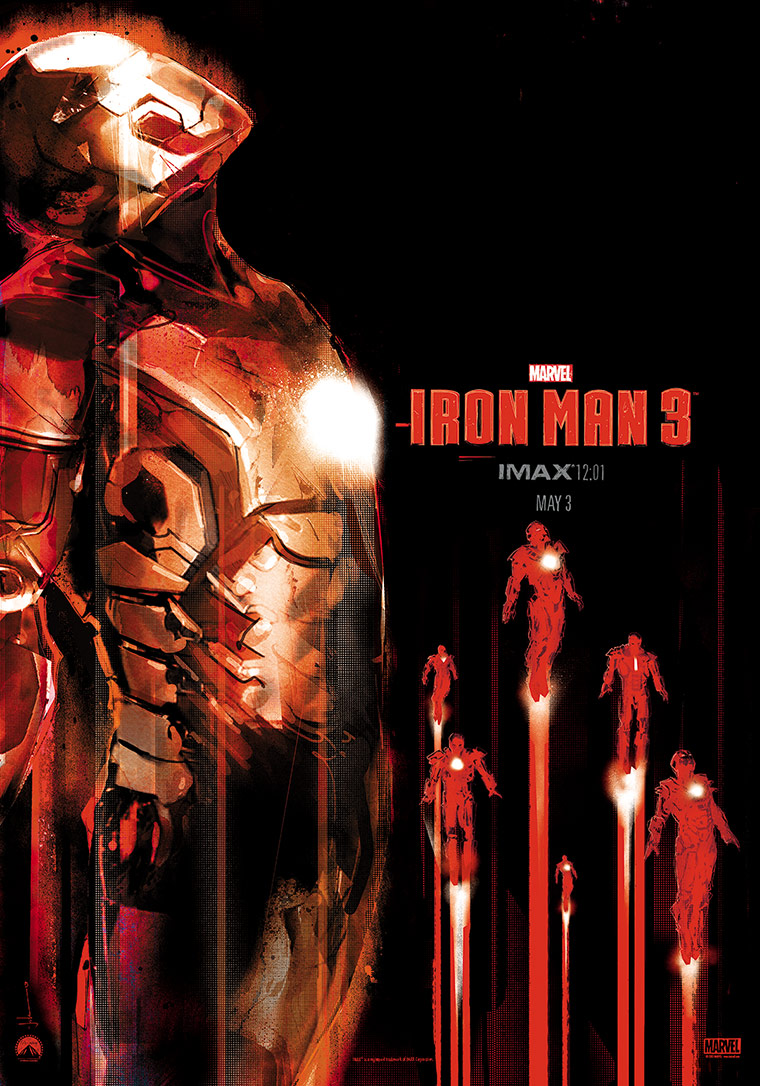
Review: Iron Man Three

(Dir: Shane Black, 2013)

A curious thing happened in the run up to Iron Man Three. With all the so-called first wave Marvel films (The Incredible Hulk possibly excepted) I experienced huge amounts of excitement and  anticipation thanks to the quality the series very quickly established, but in the build up to the third Iron Man film I was perplexed that I was feeling none of that. My only conclusion is that the let-down of The Avengers was to blame. Not only is that the weakest and least enjoyable of the first wave of films, the bewildering "popular" opinion that's permeated around it being one of the best superhero movies ever made only serves to taint the franchise somewhat. Of course I shouldn't let it do so, but sometimes these things can't be helped. (Full review here). And so it took a rewatch of the unfairly maligned Iron Man 2 to kickstart some of the excitement that should be there, as after all I do love the Iron Man films (read my summary of all first wave Marvel films).

The third film sets things off, after a little flashback detour to the end of the nineties, a little way post the events of The Avengers and introduces us to a new villain and a selection of other suspicious faces who are intent on some form of destruction, requiring someone in a metal suit to stop them. Whilst the first and particularly the second film introduced the S.H.I.E.L.D angle and agents Coulson, Romanov and Nick Fury, all intending to build up to something bigger, this film is free of those constraints featuring none of the characters from the bigger collective. It helps greatly with streamlining the story and making it feel like an Iron Man film, but what's the point in this group existing if they're not going to be called in to sort out threats such as what's taking place here?

The threat is an interesting one. Primary villain is The Mandarin (Ben Kingsley) who's presented in the vein of a middle eastern terrorist but with his own insidious plan to bring the US president (William Sadler) to his knees. The use in the first half of handheld shot, rapidly edited videos showing violence, destruction and his threats to camera are creepily effective, but what they do with him in the second half is even more curious and surprisingly works. Then there's Guy Pearce's Aldrich Killian who instantly appears devious and not all there, and as you'd expect Pearce does a decent job playing up the character in a similar way to Sam Rockwell's presence in the second film. Less effective is the Maya Hansen character (Rebecca Hall) who feels underused, especially when the science she's working on could've used more time and what we're supposed to think of her is somewhat confused.


Of course with any Iron Man film it's really the Robert Downey Jr / Tony Stark show. He is everyone's favourite loveable asshole after all. The first film saw him develop a conscious about profiteering from war, whilst the second showed us he could play with others and felt the weight of his family's legacy. The Tony Stark character development this time extends to coping with feelings of his own mortality and understanding what really is most important to him. As ever this is needed to soften out his arrogant edges, but he remains a compelling character so it's nice to keep getting little pieces of the puzzle added. With that in mind it's a shame that nothing is added to Pepper Potts (Gwyneth Paltrow), who started out well but since The Avengers has become more annoying and one-note.

Where Iron Man Three loses it's way is with the biological tweaking of the bad guys - it makes for very interesting visual effects but feels a step too far in the wrong direction from the tech heavy focus of the prior two films. Yes the technology may always seem a little unrealistic but it's believable that we'd get there at some point in the near future, whereas this biological idea is just too fantastical, even in the context of setting this after an alien attack on New York. The visual effects are as impressive as ever but the climax is a borderline indistinguishable blur of CGI and explosions and I can only imagine what an indecipherable mess this would've been in 3D.

Iron Man Three fits neatly into the little world that's been presented to us and it's a decent sequel, but it's just not quite as good as either of the first two films. It's more of the same which is fine, but doesn't feel like it's moved on substantially enough, and as intriguing as the villains (or elements of them) are, they don't compare to either Whiplash or Justin Hammer in the second film. Shane Black was a decent replacement writer / director to bring on board for Jon Favreau (I was pleased to see him reprise his role of Happy) and as is typical of Black the script is decent. But what now? If (and it presently seems a big if) they do a fourth film, it'll need to work a lot harder to be worthwhile. More intriguing however is whether Thor: The Dark World and Captain America: The Winter Soldier can maintain the very high quality of their respective first films. The Marvel universe remains enticing, for now.

5 May 2013

Review: Byzantium

(Dir: Neil Jordan, 2013)

Is there anything remotely interesting left to show audiences about vampires? If the recent media over-saturation hasn't already driven you to your coffin, don't forget the idea has existed in folkloric storytelling for centuries and will likely never die. What then can a film like Byzantium hope to offer audiences that hasn't already been seen or said, even if it is from Neil Jordan who brought Interview With the Vampire to the screen?

Based on a lesser known stage play by Moira Buffini that she also adapted for the screen, Byzantium follows Clara (Gemma Arterton) and Eleanor (Saoirse Ronan) who find themselves fleeing to a British seaside town after their secret is yet again exposed, which turns out to be a place where the past lingers heavily for them as they do what they must to survive and establish some sort of temporary life here.

Buffini has claimed that she wanted to write a story where vampires aren't the typically glamourous, male focused, all-powerful beings. Instead they're a whore and a schoolgirl, representing what's perceived to be weaker members of society, with the vampyric element inspired by older folklore visions of the creatures that saw them as far from glamourous superbeings. Life is a struggle for these characters as it always has been, which is the point. This representation seems to work and means we get interesting elements such as the conceit about how they feed / kill their victims.


What's less satisfactory, and part of this may just be a personal thing, is the primary setting of the film. At the best of times British seaside resorts are drab, depressing places so in turn this gives the film an unappetising tone. A focus on the grey concreteness of promenades and walkways, dreary colour from fairgrounds, the elderly who are just sitting in Death's waiting room and the dated semi run-down guest house that serves as a base for our leads, all emphasises the struggling almost "kitchen sink" angle of the film, but this doesn't engage. More enticing is the stunning Western Irish scenery of an ominous island and it's cascading waterfalls, which mostly fall into the historical part of the story that turns out to be the most intriguing aspect. The transitions between present and past work however the film would've been improved by spending more time here, partly because it feels like there is plenty of background and mythology left uncovered. This portion of the film is where we see both Sam Riley and Johnny Lee Miller; the former is under-developed yet you feel there's a lot more to understand about his character, whilst Miller hams it up.

As for the leads, Arterton's character feels a little too one note, caring only about the pairs survival and moving forwards. Her broad accent suits the setting but again it feels like there's too much unrevelead as the focus too frequently falls on her ample cleavage. Ronan provides the depth, with her character in a more complex situation as the frustrated sixteen year old who's been alive for two centuries and has some sort of ethical code about feeding, yet is sick to death of secrets. She's the best thing in the film and fortunately is the focus. The other notable is Caleb Landry-Jones who, as love interest for Eleanor, is compelling but feels like he's wandered in from another film, almost as if he's playing an extension of his character Syd from Antiviral (review here) but with less interesting material and a weirdly distracting accent.

Byzantium sits slightly awkwardly between two worlds as it tries to balance the mythical with the normality of life, which is perhaps a route lesser seen when it comes to vampire stories. Cutting back on many of the tropes of the genre, such as no aversion to sunlight or fangs for example, is a real positive as it makes the film feel a little different, but unsurprisingly it's this side of the story that remains most interesting and the normality angle that drags it down. Perhaps if the present day setting was more enticing I'd have less of an issue and wouldn't have wanted to spend more time in their past. Byzantium isn't bad, it just teases that there's a potentially much better story hidden somewhere within this material.