28 May 2013

Review: The Hangover Part III

(Dir: Todd Phillips, 2013)

To say The Hangover Part III had it's work cut out for it would be something of an understatement. It's left sitting in an awkward position of not wanting to do the same thing as the first two films whereas trying to do something different is a risky strategy. Part II's major failing was that it was the exact same plot transplanted from Vegas to Bangkok, with identical story beats and "comedic" moments. This lack of originality rendered it entirely predictable and the humour forced. It was the perfect example of how not to do a sequel and a massive unfunny failure (except of course at the box office where it reaped massive amounts of money). The first film wasn't perfect but it felt like a fresh comedy with an approach that was genuinely intriguing whilst leveraging some great comedic moments.

Part III (wisely) takes the different approach. There are no hangovers or blacked out moments that need re-piecing together, instead it's a through story tenuously linking back to the first film, that tries to give us as much of Leslie Chow (Ken Jeong) as possible and offers new threat in the form of John Goodman's crime boss Marshall, who forces the Wolfpack into a new range of wild situations.

Although it was probably the right decision to push the story off in another direction, the chosen route doesn't really work. In fact it's quite hard work, going for bland thrills and action. The set-up that gets the group on the road makes sense, yet it's pretty boring and the story continues in this dull manner all the way until it hits Vegas somewhere after the halfway point, where it shows small glimmers of life. But only small glimmers. Vegas is where the heart of the series lies, but this ends up as yet another pale pale reminder of the first film.


Part of the problem lies with the characters. Man-child Alan (Zach Galifianakis) is more annoying than ever, and his schtick already feels done to death with Galifianakis playing variations of this character in both Due Date and The Campaign. Alan is a thin character who's finally stretched beyond breaking point in this third film. The others have become even more generic with only Bradley Cooper seemingly coming out unscathed by virtue of being the least annoying. Yes there's something vaguely comfortable about being in their presence but it's a rapidly diminishing notion. Chow's screeching mania is funny in small doses and as such worked in the original film, but has been totally over-used since then rendering it impotent.

And this is the big problem - both Alan and Chow are supposed to be the primary comic relief and the pair are rarely funny here. I managed a handful of mild chuckles throughout, but there were only two proper genuine laughs in the film, and one came in the scene during the end credits rather than the actual film! What Part III is not is funny. It's just dull blandness. The irony about the aforementioned end credit scene is that it cruelly rubs the potential for a better film in our face.

Two sequels in and it's clear The Hangover was lightning in a bottle, being that rare comedy that's genuinely funny, surprising and entertaining. But these sequels have done their best to shatter that bottle rather than preserve what it contained. Part III barely registers on the comedy scale whilst offering bland action and irritating characters at best. It's better than it's predecessor by the simple virtue of not being a straight retread. The couple of good ideas (Melissa McCarthy's small role for example) just frustratingly highlight where the film could've gone for the better. Perhaps taking a different route with the second film and heading back to a retread with the third film may have been a better approach, but either way, The Hangover series is now most definitely dead in the water.

15 May 2013

Review: Star Trek Into Darkness

(Dir: J.J. Abrams, 2013)

The 2009 version of Star Trek proved one thing very successfully - that some films / tv shows are worth rebooting. The decision a couple of decades back to move Star Trek films into the Next Generation timeline was highly successful as that was the biggest of the three iterations of the universe on tv at the time. But those films eventually grew bland and tiresome. For an enduring franchise like Star Trek sometimes a new approach is required, and what J.J. Abram's offered with Star Trek was even more wholly satisfying than expected, primarily because of the casting, characterisation and their interplay. And not forgetting that it's a decent modern sci-fi / action movie.

So you'd think the hard work is done as they know what works and that a sequel is now just happy plain sailing, right? Well, Into Darkness proves that's not entirely so. The entire crew are of course back with a small handful of fresh faces and there's the inevitable new villain in the shape of Benedict Cumberbatch's John Harrison, although that name may just be a façade (implying that is only really a mild spoiler as if you followed any of the build up to the film his real identity was widely rumoured). And thus he becomes the greatest foe this still fledgling crew has had to face yet.

So what seems to have gone wrong along the way? The plot of Into Darkness really stretches patience as it's just flat out boring or at times derivative of the last film. After a mildly exciting intro sequence and some interesting Earth bound scenes the Enterprise takes flight and this is where the film should come to life, but no, it labours away with a story that barely seems to leave the ship and doesn't involve any of the other rich or exciting alien life forms created in this universe, save for some cursory Klingon action which is a brief opportunity wasted. When there's so much potential in this world why limit yourself so much? It's only the scenes on Earth that really seem to have something engaging about them, which is a damn shame. 


None of this is helped by the villain who is pretty rubbish (if you don't want spoilers don't read this paragraph). The decision to make him Khan seems entirely nonsensical in this iteration of the universe and incredibly lazy. I'm still struggling to figure out how he logically fits into this story although I'm not entirely au fait with this whole universe so maybe I'm missing something? Either way I get frustrated when filmmakers feel they must just replicate what previous films did, you know because Star Trek II: The Wrath of Khan was the most popular we must try replicate it in our sequel. No, have confidence in your material and do something more creative. None of this is helped by Cumberbatch's terrible acting. He's as stiff as a board and the way he looks like he's over-enunciating words may work on stage but here it just looks stupid, diminishing his impact. Having only seen him in Tinker Tailor Soldier Spy and War Horse I'm kinda confused why people seem to think he's such a great actor.

Where the film does work is back in the interplay of the key characters that everyone knows and loves. Kirk (Chris Pine) and Spock (Zachary Quinto) are still up to their usual verbal sparring which is great to watch, whilst both Bones (Karl Urban) with his quasi-serious concern and Scotty (Simon Pegg) with his hyperactive mania both continue to provide decent light relief. Fortunately the misguided Uhura (Zoe Saldana) and Spock love storyline from the last film is mostly sidelined here. Likewise JJ Abrams seems to have curtailed his overly distracting use of lens flair. I hasten to say it's more tastefully used rather than constantly blinding us, but perhaps this is because it would be too much for those choosing to watch in 3D?

This might be the best summation of Star Trek Into Darkness I can think of - when I sat in the cinema watching Star Trek I didn't want it to end and could've happily spent another hour absorbed in the world, whilst at the halfway point of Into Darkness I already couldn't wait for it to end. This proves to be a pretty compelling example of no matter how good and interesting the characters are, it's unlikely they'll transcend a boring plot. I'm still bemused why with such scope in the Star Trek universe you'd limit yourself to a human villain and ignore the interesting alien worlds. And that villain is just lazy and poorly acted, making Eric Bana's so-so Nero in the last film look like a masterpiece of villainy. Into Darkness is highly unsatisfying and curiously, it seems the old "odd numbered Star Trek movies are bad, even numbered are good" paradigm has been reset in the opposite direction with this new run of films.

11 May 2013

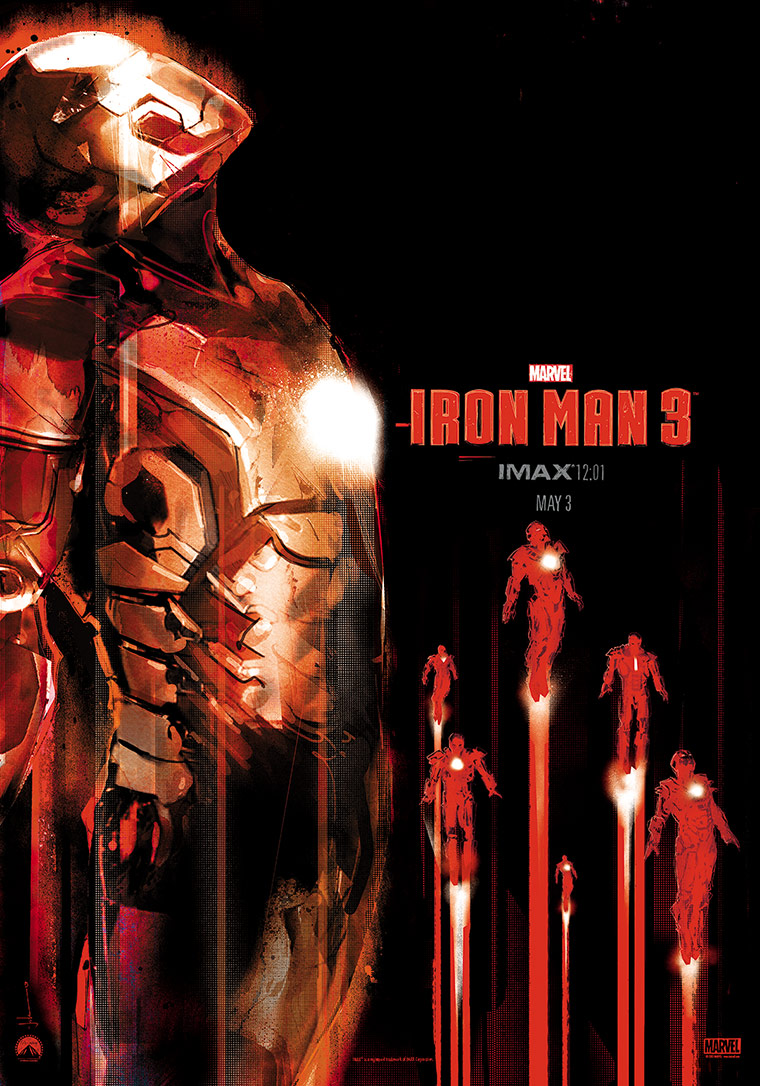
Review: Iron Man Three

(Dir: Shane Black, 2013)

A curious thing happened in the run up to Iron Man Three. With all the so-called first wave Marvel films (The Incredible Hulk possibly excepted) I experienced huge amounts of excitement and  anticipation thanks to the quality the series very quickly established, but in the build up to the third Iron Man film I was perplexed that I was feeling none of that. My only conclusion is that the let-down of The Avengers was to blame. Not only is that the weakest and least enjoyable of the first wave of films, the bewildering "popular" opinion that's permeated around it being one of the best superhero movies ever made only serves to taint the franchise somewhat. Of course I shouldn't let it do so, but sometimes these things can't be helped. (Full review here). And so it took a rewatch of the unfairly maligned Iron Man 2 to kickstart some of the excitement that should be there, as after all I do love the Iron Man films (read my summary of all first wave Marvel films).

The third film sets things off, after a little flashback detour to the end of the nineties, a little way post the events of The Avengers and introduces us to a new villain and a selection of other suspicious faces who are intent on some form of destruction, requiring someone in a metal suit to stop them. Whilst the first and particularly the second film introduced the S.H.I.E.L.D angle and agents Coulson, Romanov and Nick Fury, all intending to build up to something bigger, this film is free of those constraints featuring none of the characters from the bigger collective. It helps greatly with streamlining the story and making it feel like an Iron Man film, but what's the point in this group existing if they're not going to be called in to sort out threats such as what's taking place here?

The threat is an interesting one. Primary villain is The Mandarin (Ben Kingsley) who's presented in the vein of a middle eastern terrorist but with his own insidious plan to bring the US president (William Sadler) to his knees. The use in the first half of handheld shot, rapidly edited videos showing violence, destruction and his threats to camera are creepily effective, but what they do with him in the second half is even more curious and surprisingly works. Then there's Guy Pearce's Aldrich Killian who instantly appears devious and not all there, and as you'd expect Pearce does a decent job playing up the character in a similar way to Sam Rockwell's presence in the second film. Less effective is the Maya Hansen character (Rebecca Hall) who feels underused, especially when the science she's working on could've used more time and what we're supposed to think of her is somewhat confused.


Of course with any Iron Man film it's really the Robert Downey Jr / Tony Stark show. He is everyone's favourite loveable asshole after all. The first film saw him develop a conscious about profiteering from war, whilst the second showed us he could play with others and felt the weight of his family's legacy. The Tony Stark character development this time extends to coping with feelings of his own mortality and understanding what really is most important to him. As ever this is needed to soften out his arrogant edges, but he remains a compelling character so it's nice to keep getting little pieces of the puzzle added. With that in mind it's a shame that nothing is added to Pepper Potts (Gwyneth Paltrow), who started out well but since The Avengers has become more annoying and one-note.

Where Iron Man Three loses it's way is with the biological tweaking of the bad guys - it makes for very interesting visual effects but feels a step too far in the wrong direction from the tech heavy focus of the prior two films. Yes the technology may always seem a little unrealistic but it's believable that we'd get there at some point in the near future, whereas this biological idea is just too fantastical, even in the context of setting this after an alien attack on New York. The visual effects are as impressive as ever but the climax is a borderline indistinguishable blur of CGI and explosions and I can only imagine what an indecipherable mess this would've been in 3D.

Iron Man Three fits neatly into the little world that's been presented to us and it's a decent sequel, but it's just not quite as good as either of the first two films. It's more of the same which is fine, but doesn't feel like it's moved on substantially enough, and as intriguing as the villains (or elements of them) are, they don't compare to either Whiplash or Justin Hammer in the second film. Shane Black was a decent replacement writer / director to bring on board for Jon Favreau (I was pleased to see him reprise his role of Happy) and as is typical of Black the script is decent. But what now? If (and it presently seems a big if) they do a fourth film, it'll need to work a lot harder to be worthwhile. More intriguing however is whether Thor: The Dark World and Captain America: The Winter Soldier can maintain the very high quality of their respective first films. The Marvel universe remains enticing, for now.

5 May 2013

Review: Byzantium

(Dir: Neil Jordan, 2013)

Is there anything remotely interesting left to show audiences about vampires? If the recent media over-saturation hasn't already driven you to your coffin, don't forget the idea has existed in folkloric storytelling for centuries and will likely never die. What then can a film like Byzantium hope to offer audiences that hasn't already been seen or said, even if it is from Neil Jordan who brought Interview With the Vampire to the screen?

Based on a lesser known stage play by Moira Buffini that she also adapted for the screen, Byzantium follows Clara (Gemma Arterton) and Eleanor (Saoirse Ronan) who find themselves fleeing to a British seaside town after their secret is yet again exposed, which turns out to be a place where the past lingers heavily for them as they do what they must to survive and establish some sort of temporary life here.

Buffini has claimed that she wanted to write a story where vampires aren't the typically glamourous, male focused, all-powerful beings. Instead they're a whore and a schoolgirl, representing what's perceived to be weaker members of society, with the vampyric element inspired by older folklore visions of the creatures that saw them as far from glamourous superbeings. Life is a struggle for these characters as it always has been, which is the point. This representation seems to work and means we get interesting elements such as the conceit about how they feed / kill their victims.


What's less satisfactory, and part of this may just be a personal thing, is the primary setting of the film. At the best of times British seaside resorts are drab, depressing places so in turn this gives the film an unappetising tone. A focus on the grey concreteness of promenades and walkways, dreary colour from fairgrounds, the elderly who are just sitting in Death's waiting room and the dated semi run-down guest house that serves as a base for our leads, all emphasises the struggling almost "kitchen sink" angle of the film, but this doesn't engage. More enticing is the stunning Western Irish scenery of an ominous island and it's cascading waterfalls, which mostly fall into the historical part of the story that turns out to be the most intriguing aspect. The transitions between present and past work however the film would've been improved by spending more time here, partly because it feels like there is plenty of background and mythology left uncovered. This portion of the film is where we see both Sam Riley and Johnny Lee Miller; the former is under-developed yet you feel there's a lot more to understand about his character, whilst Miller hams it up.

As for the leads, Arterton's character feels a little too one note, caring only about the pairs survival and moving forwards. Her broad accent suits the setting but again it feels like there's too much unrevelead as the focus too frequently falls on her ample cleavage. Ronan provides the depth, with her character in a more complex situation as the frustrated sixteen year old who's been alive for two centuries and has some sort of ethical code about feeding, yet is sick to death of secrets. She's the best thing in the film and fortunately is the focus. The other notable is Caleb Landry-Jones who, as love interest for Eleanor, is compelling but feels like he's wandered in from another film, almost as if he's playing an extension of his character Syd from Antiviral (review here) but with less interesting material and a weirdly distracting accent.

Byzantium sits slightly awkwardly between two worlds as it tries to balance the mythical with the normality of life, which is perhaps a route lesser seen when it comes to vampire stories. Cutting back on many of the tropes of the genre, such as no aversion to sunlight or fangs for example, is a real positive as it makes the film feel a little different, but unsurprisingly it's this side of the story that remains most interesting and the normality angle that drags it down. Perhaps if the present day setting was more enticing I'd have less of an issue and wouldn't have wanted to spend more time in their past. Byzantium isn't bad, it just teases that there's a potentially much better story hidden somewhere within this material.

22 April 2013

Review: Olympus Has Fallen

(Dir: Antoine Fuqua, 2013)

The most interesting thing about Olympus Has Fallen is how easy it makes it look for terrorists to take over the White House. As the chief villain Kang (Rick Yune) says, it took them only thirteen minutes to do so. Anyone remember that later season of 24 where a similar thing happened? In the case of Olympus Has Fallen it's a bunch of renegade North Koreans (or Democratic People's Republic of Korea as they insist on unironically being called), who we're to believe have the skill, ability and capacity to break into and overthrow one of the most protected places on Earth. Ok, let's set aside reality for a minute, I can suspend my disbelief, this is Hollywood. And if the President looked like Aaron Eckhart we'd all want to vote for him right?

Stepping into the John McClane role in what is essentially a direct retread of Die Hard is Gerard Butler. He's ex Secret Service, he once saved the President's life (see the first ten minutes of the film, just so we know) and he gets himself into the right place at the right time so he can fuck up Kang's shit (I can't remember if that's a direct quote or if I'm paraphrasing). Butler proves two things whilst threatening to jam a knife into a brain (another direct quote) - he can convincingly handle action scenes (he's quite fun to watch in that mode) and he's really really not a good actor. He helped make 300 thoroughly enjoyable, but can you name another film where his presence actually added to it? I'm struggling.


The script goes a long long way towards enhancing the woodeness of not only Butler's acting but the whole ensemble. This is the first film by the writers - here's hoping we don't get more. Eckhart probably took this role because he got to play president but he's relegated to the background and gets time to work on how to look pissed off whilst cable tied. He's proven in the past that he's a far better actor than this. Morgan Freeman fulfils what appears to be his sole purpose in films these days, to pop up for a bit and add a touch of gravitas. This is another easy paycheck for him, just like last week's Oblivion (read review). And what of Robert Forster's boorish general or Melissa Leo's Secretary of Defense? Nothing to see here other than cliché. Yune fulfils the villain role satisfactorily, with snarling menace and the requisite gleeful aplomb.

Most curious is how timely this American demonising of the North Koreans is both here and in the recent Red Dawn remake. This amounts to propaganda for brainwashing the masses; forget about the Middle East and the pesky Russians, no, this is the new enemy and they seem like commies, have nukes and hate the good ol' US of A. Recent real life tension between these countries is just damn fortunate timing. The US response apparently needs always be decisive and violent and in Olympus Has Fallen it's jarringly so, in a way that feels excessive probably to all but those with the deepest patriotism running through their veins. (Best not point out it's a Scot with a dodgy American accent who saves the day!).

If it wasn't already clear from my sardonic tone, Olympus Has Fallen is bad. The story is pure filtered cliché with a risible script and acting so wooden it gives off splinters. Gunfire and explosions alone do not a good film make. It's about the taking of a temple of pure Americanism so the jingoism is expected, but it's so heavy handed it never sits easy. As the film plays it totally straight it's impossible to watch and not constantly hear in your head "America, fuck yeah!!". If you like your films bad and littered with simple patriotic propaganda, Olympus Has Fallen may just be for you. I'm intrigued how White House Down will handle a similar story later this year with a domestic enemy - it can surely only be better.

21 April 2013

Review: Evil Dead

(Dir: Fede Alvarez, 2013)
 
In some respects The Evil Dead is the epitome of 1980's horror. It was a labour of love for director Sam Raimi, shot on a shoe string budget over an extended period of time, whilst having to make use of cheap and innovative homemade special effects. The whole endeavor struck the right balance of tension, shocks, gore and subtle humour. Inevitably it looks somewhat dated now but it hasn't lost any of its power. Evil Dead 2 seems to frequently be cited in somewhat more reverential breath, but it straddles that awkward line of trying to be a comedy horror and those are two concepts that rarely work in tandem. The sequel maybe comes closest to proving they can work, but the balance is less easy than in the original, which has the honour of being one of the key titles in the eighties video nasty furore. But can it be improved upon? 
 
The argument for remakes stands as follows - was the original poor but had a good idea in there somewhere? Can an intriguing and satisfyingly different take on the original story be offered? Answer yes to one or both and you may have justified the validity of producing a remake. With Evil Dead the first question is obviously null and void, but the second? Well, this is the big question for the 2013 version. Five friends go to a remote cabin in the woods to perform an intervention on the friend who's big on substance abuse. They discover the Necronomicon in a basement full of old witchery, some demons get summoned, there are possessions and... well, the story is much the same, following the same general formula and throwing in recognisable moments but in a slightly different manner. So is there a point?
 
 
One word - gore. Evil Dead 2013 takes The Evil Dead's violence and blood drenched mania and cranks it right up. This is a gorehounds dream. Gushing flumes of blood, dismemberment, self mutilation, nailguns and other similar implements for gouging, slicing and ripping all get their moment in the spotlight amongst the miasma of torn flesh. I can't think of any recent film to so gleefully revel in this. Notably all the special effects are claimed to be practical effects with no CGI used, which is a breathe of fresh air and a throwback to the spirit and feel of the original and its era (hell the original even employed stop motion effects). But as grim as it all sounds don't forget it's couched in the supernatural and slightly fantastical which happily ensures that tonally it never feels like it's veering into bleak, depressing "torture porn" territory.
 
Unfortunately gore is all the film appears to have going for it. Attempts at tension are less effective - it may not be entirely devoid of this, but it lacks the visionary ways the original plays with the isolation of the cabin or how creepy it feels when the camera takes on the persona of the evil watching through the windows. Some may argue differently about the tension, after all horror is truly subjective and I traditionally find it takes a lot to affect me, but it's worth mentioning that my viewing compatriot at times wondered why he was putting himself through this experience. A bigger issue is the cast and characters who are faceless and completely unmemorable, making rooting for their escape much harder. When you've got Bruce Campbell's Ash in the original series, who is one of the most memorable characters in horror, if you can't deliver anyone with even one tenth of his personality then what's the point? 
 
"What's the point?" pretty much sums up how I feel about Evil Dead. For director Fede Alvarez this also seems somewhat a labour of love and I suspect he had good intentions, but there's nothing about the actual story that improves on the original and it's biggest failing is absolutely the bland, boring casting. The over-the-top gore is expertly executed and fun to watch like it should be in a film like this, but if that's what Alvarez really wanted to deliver audiences then why not wrap it in something original? The recent remake of Maniac (read my review) effectively proved the point for offering an interesting different take on an existing story. Evil Dead 2013 shows that a lot more than copious buckets of blood are needed to justify a remake.

17 April 2013

Review: Oblivion

(Dir: Joseph Kosinski, 2013)

How easy is it to separate the real life of an actor from the characters we see them portray on screen? It's a particularly pertinent question when debating Tom Cruise and his frankly mental seeming personal life / "religious beliefs", or whatever fanciful term you put on it (providing it doesn't irk those excessively litigious types crying defamation). Should any of that matter and stop you from being excited about or watching his films? Personally I think no. Cruise is still one of the most engaging leading men in the business and that shows no signs of changing - just look at any of his recent work. He also signifies something very "Hollywood", which I mean in the positive terms of high quality, slick entertainment, which is always happily welcomed. And for someone who's been in the industry for over thirty years, see if you can actually even name five bad films he's been in.

So to his newest film, Oblivion. It's 2077 and Earth is decimated following an alien invasion seventy years earlier - mankind may have won but had to abandon the planet. Remnants of the invaders are still hidden and drones patrol protecting remaining tech. Jack (Cruise) is a drone repairman working with Victoria (Andrea Riseborough) who live in and operate out of a station above the clouds within their sector. But something crashes to Earth that leads Jack to challenge everything he knows and the effectiveness of his team.


The first point to make is how satisfying it is to see an original big budget sci-fi film, as they don't seem to come along too often these days. You may read in the credits that it's based on a graphic novel, but that's something director Joseph Kosinski created in order to get the film made. In the grand tradition of the best sci-fi Oblivion is a fantastic looking film. The barren, bleak Earth and the pointed remains of landmarks contrast perfectly with the slick, clean futuristic design of the drones, Jack's spaceship and the stunning living quarters above the clouds. It's something of a widescreen visual treat and the confident production design is convincing.

Cruise is, as you'd expect, his usual reliable self, offering nothing ground breaking or that particularly different. Sure Jack lacks the personality traits of an Ethan Hunt or Jack Reacher, but he's still an interesting lead and eminently watchable, despite the film at times veering into "Tom Cruise worship" territory. Riseborough is the next most prevalent person in Oblivion and she constantly leaves you wondering what's behind the clinical, steely veneer. Both Olga Kurylenko and Morgan Freeman pop up along the way but neither are particularly memorable.

More important in a film like this is how the story functions. The idea itself is excellent and in terms of delivery it's mostly successful, at times benefiting from an appealing sense of mystery. One of the big reveals feels like a massive facepalm moment, but it manages to bring it back round positively. There are still plotholes and a couple of lapses in science but these can be easy to forgive, although the film does end up showing too many flashbacks which only serve to distract from the more interesting scenes set in 2077. What however is entirely successful is the soundtrack by M83, which is the one element that makes Oblivion fly. Suitably electronic to have a futuristic feel that satisfyingly merges with the more composed elements of the score, it's constant rippling undercurrent feels like the glue that holds the film together. But this should come as no surprise considering Kosinski had Daft Punk score his last film TRON: Legacy, which quite frankly was a match made in heaven. Sometimes it's these smaller details that make all the difference.

Kosinski was the right director for Oblivion. He nails the look, sound and feel of it, whilst successfully shepherding an interesting story that delivers when required too. Cruise is Cruise and that of course is absolutely fine as he's always good to watch. Oblivion's a decent sci-fi film; it's not revolutionary but it's definitely a very entertaining two hours.