27 October 2018

London Film Festival Review: Widows

(Dir: Steve McQueen, 2018)

The simple suggestion of Steve McQueen directing a heist thriller put Widows at the top of this years London Film Festival must-watch list. It's been almost five years since 12 Years A Slave, his last film, and he continues to be one of the most exciting directors working today. Hence the excitement about what he could bring and how he could twist a genre that's been done to death.

From the get go his creative fire and love of using the camera in unexpected ways is on display – the opening few minutes showcase a car chase shot on a single camera providing a character-focused perspective on events, putting us inside the action, whilst jarring edits jump back in time to brief scenes involving those in the vehicle, establishing context. It's a masterful start, and when you pay attention to the casting you are forced to check your usual expectations about who the key players actually are.

This is very much a character piece, and Viola Davis' Veronica is a powerful lead, pushed into a shitty situation and forced to react as she only knows how. There's a steely determination on show, seemingly ice-cold on the surface but churning underneath with a depth of emotion that rises up in private. She's joined by Michelle Rodriguez's Linda, Elizabeth Debicki's Alice and Cynthia Erivo's Belle. All have their own issues to deal with but are thrust together and form a great unit. These are fascinating, well-written characters with great performances bringing each to life, as they learn to utilise the skills they didn't know they had.
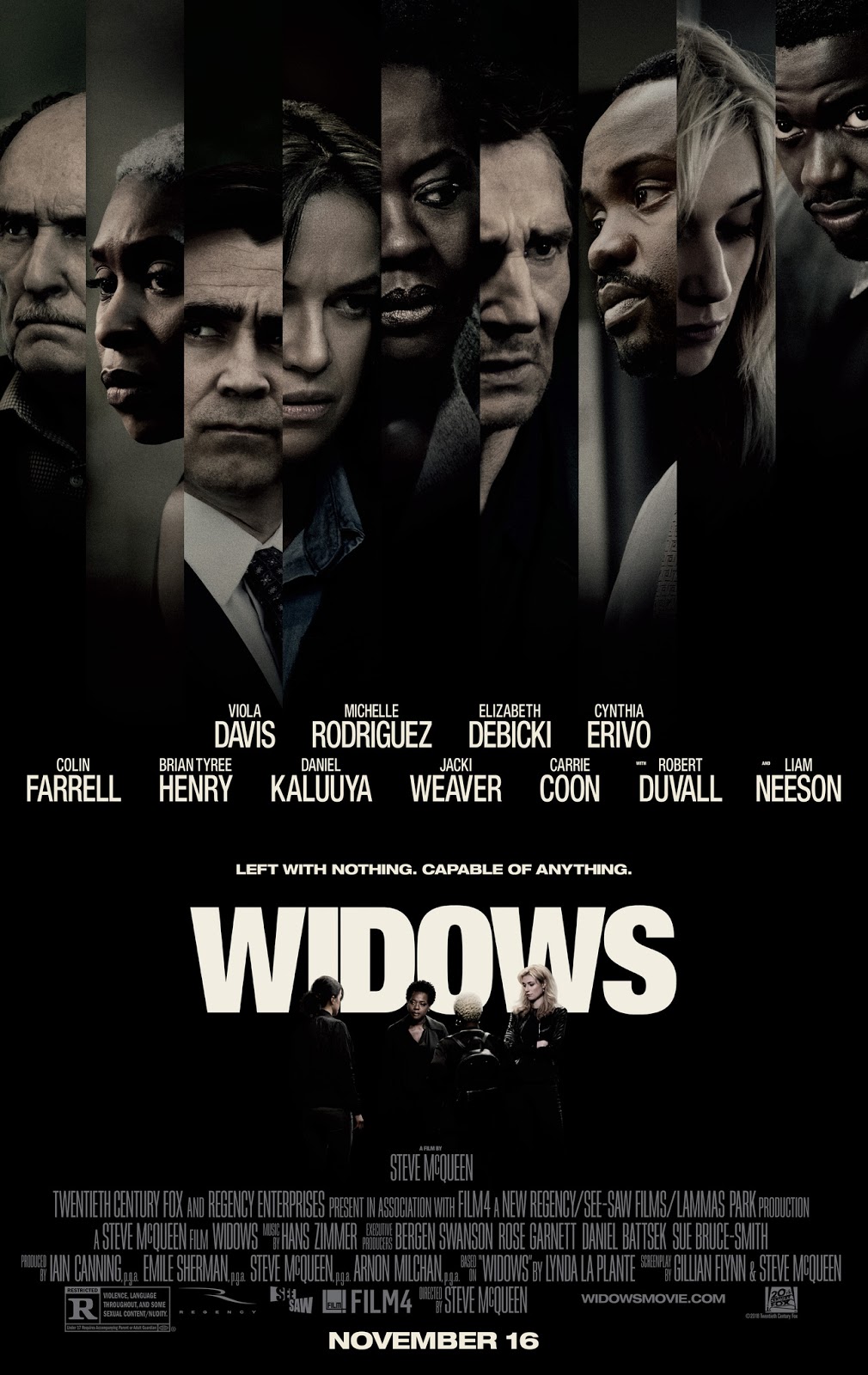

The heist and its planning are well executed, but Widows is more focused on a host of societal issues. Set in a Chicago district there's a huge amount of politics at play: from the privileged Mulligan family (Colin Farrell and Robert Duvall) who – mostly – see it as their family right to run this part of the city and profit accordingly, to brothers Jamal (Brian Tyree Henry) and Jatemme (Daniel Kaluuya) who believe that politics and the inherent corruption is the legitimate way to expand their criminal enterprises; to how the church can sway an election, the impact of zonal redistricting and the smoke and mirrors of publicly embracing black female business owners whilst keeping them indebted to a white paymaster. Not to mention what one has to do to survive as a single parent.

Widows is clearly more than just a standard heist thriller and these extra layers are core to it's success. Creatively speaking it does feel like McQueen's most conventional film, but that still puts it ahead of the abilities of most directors and it's full of fascinating little flourishes – the car ride Farrell's character takes home after an event is a prime example as it works on so many levels. But again it's how he uses and positions the camera – what does he show us, what does he stop us seeing and what is our perspective for it all? Ultimately the film is so successful because of the characters, acting and writing – predominantly the four leads but also the supporting cast, especially the supremely menacing Kaluuya. Widows may well end up being one of the best films of the year.

7 October 2018

Review: Venom

(Dir: Reuben Fleischer, 2018)

Venom is the closest any of the films in the modern Marvel sphere have gotten to horror (we're talking about the post Blade trilogy Marvel renaissance of course, and it should be noted that Venom is not part of their bigger universe). No-one could actually claim it as a horror film, but the first half intriguingly toys with dark atmospherics, allusions to zombie flicks and body horror. And of course there's the Venom character himself – an horrific looking alien, all razor sharp teeth, slithering skin, demonic bug eyes and that muscularly lolling tongue. He's superbly realised on screen; surely the stuff of nightmares for some. He takes a little while to appear but how he's revealed through his symbiosis with Eddie Brock (Tom Hardy) is effective.


Hardy is a solid choice for Brock with his cross of muscularity, intelligence and ability to pull off the requisite physical comedy. Initially he's particularly engaging, almost playing against type as a happy, successful, erudite reporter. Although he all too quickly descends into the more commonly seen moody Hardy, but clearly has free reign to go a little crazy in the role. Once past the dark set-up (it's a shame it never follows through on the horror vibe!) it all regresses into standard overblown, action-heavy beats. The overarching plot is a rudimentary, by-the-numbers, got to stop a megalomaniac bad guy story. It serves it's purpose for getting Brock to Venom, but beyond that it distracts from the real, more interesting story of Brock and Venom becoming "we".

There are plenty of comedic overtones at play which offers some balance. This is particularly effective in the form of the Brock/Venom dialogue but it could've used even more of this. The way Venom's voice has been mixed into the overall sound design of the film is slightly jarring and disorientating, which was a smart decision. But on the other hand it's all frustratingly bloodless. We're in a post Deadpool / Logan world where the reality of the violence meted out by comic book characters is writ in crimson and riddled with body parts – so it is disappointing to not see that applied to such a dark character (he has a penchant for biting off people's heads after all!). It is however refreshing to see love interest Anne (Michelle Williams) be a strong character. She may be under-utilised but is thankfully not pushed into the old damsel in distress scenario. Whereas Riz Ahmed plays Carlton Drake with a manically predictable megalomania, but always feels too young, despite clearly trying to ape today's young billionaire tech CEO's.

Venom is an entertaining first attempt at the character (forgetting Spider-Man 3 of course) and there's certainly more to like than dislike. A sequel direction has been teased – let's just hope it pushes the character angle more than the OTT CGI action, whilst amping up the comedic dialogue and the bloody violence.

19 May 2018

Review: Avengers: Infinity War

(Dir: Anthony Russo & Joe Russo, 2018)

So here we are; nineteen films into the Marvel Cinematic Universe and quite unexpectedly Avengers: Infinity War, the biggest team-up to date and part one of the supposed culmination to the overarching story, is not a total disaster. In fact, far from it. The most telling reason why is the presence of the Guardians of the Galaxy cast and their prominence in the film – they're not the lead characters, no-one is really, but considering their previous separate existence they get a solid amount of screen time here. Expectedly this thoroughly ups the entertainment factor, providing loads of humour and allowing for more fantastical off-Earth scenes. Most of the Marvel films have become oh so serious, so the presence of Rocket, Groot, Drax, Star Lord and Gamora just raises the spirits of the viewer (unless you actually dislike these characters!), offering more snarky wit. Equally, the involvement of Dr Stephen Strange adds another dimension that was never previously present, and having now properly established the Spider-Man character in Homecoming ensures his role here is welcomed (rather than that awkward attempt to shoe-horn him in last time solely because the source material demanded it – one of the many failings of Civil War).

Whilst having all these characters on-board totally lifts Infinity War, it really emphasises just how unexciting it's become watching (almost all of) the core Avengers. Both Iron Man/Tony Stark and Captain America/Steve Rogers have become utterly boring characters – long gone is the joie de vivre and inspiring sense of duty. Now they're just tiredly written and tiredly acted, with both Robert Downey Jr and Chris Evans clearly just going through the motions – a position they've been forced into over recent films. Thankfully they're overshadowed here. Similarly both Falcon and Rhodey, who were quickly assimilated into the group, offer little of anything, whilst Red Witch and Vision still seem out of place having never been portrayed interestingly. The ploy of playing Hulk/Bruce Banner off against how he was used in Thor: Ragnarok does work, and speaking of Thor, he still remains the best and most interesting of this group.


The big surprise here is Thanos. The way things usually roll with anthropomorphised-but-not-quite-human CGI villains is an awkward attempt at believability, thus they lack any real perception of threat let alone anything for the viewer to grasp onto. Something about this character still doesn't seem right visually, however he's really well written and voiced – Josh Brolin offers a strong sense of pathos that makes him a little more erudite and thoughtful than the bombastic all-destroying villain he'd been billed as. This makes him all the more interesting as it's possible to see his point of view, taking it beyond the usual megalomania of ruling the world and destroying it just because.

Infinity War is a film led by a continual march of action scenes, none of which astound or offer anything new, but all prove enjoyable (typical modern blockbuster!). However it's when it pulls back to the characters new to the Avengers films that it really flies. It's just a shame that since the first phase of films the core Earth-bound characters have been written into such dull story lines that they've become a chore to watch (yes there is something interesting in the relevance of heroes and who they are accountable too, just not in the approach that's been taken). And the problem with this number of characters means the newer ones whom people might want to see, like Black Panther / King T'Challa, are given short thrift. Nonetheless Infinity War proves to be the most enjoyable team-up yet in this series, concluding in the way you don't actually expect it will, even if the ultimate resolution in next year's part four is kind of obvious. So it's third time lucky for the Russo brothers making an interesting film in this series – but had Joss Whedon gotten a third go, would he have been blessed with such luck too?

15 May 2018

Review: A Quiet Place

(Dir: John Krasinski, 2018)

How much faith do you have in your fellow cinema-goer? Presented with a Friday night free to go to the cinema I had doubts about whether it was actually worth watching A Quiet Place in an auditorium filled with other people (on opening night in Leicester Square no less). You know, the popcorn-munching, sweet wrapper-rustling, not so subtly talking, perpetually phone-checking masses who seem to populate cinemas these days. Would it be worth sacrificing the massive screen and immersive sound for the controlled isolation of a home viewing experience in a few months time? Fortunately the answer was no as it (amazingly) turned out to be a respectful audience. A Quiet Place is a hell of an atmospheric film, putting a lot of weight into it's sound design and the very concept of silence, clearly gripping the entire audience. The tagline sums the plot up nice and succinctly – if they can hear you they can kill you – but it's more than that. With the sole cast members comprising the family headed by John Krasinski and Emily Blunt, it feels more character driven than expected. We work through the family's unique dynamic and understand how they manage to survive, mostly resorting to sign language to communicate, rarely able to utter a word unless it's a whisper. These linguistic limitations certainly enhance the film.


A sinuous tension roils beneath the surface as we wait for the one inevitable sound that will summon a rapid, savage attack by these mysterious creatures. And when it comes it's all controlled masterfully, with a handful of breathtaking set pieces that leave you teetering on the edge of your seat. Krasinski, who directed the film, gets the balance between the suspense, horror and quieter family moments just right – neither overdoing it nor leaving you feeling as if it's lacking. We only get little snippets of information about the creatures and why they're on Earth and that's enough, as there's greater fear in knowing less. Admirably the prologue jumps straight into an incident that directly affects the family 80 days in rather than focusing on how they survived the initial onslaught, which in other hands would be the more obvious way to kick things off. The overall brevity helps too.

A Quiet Place is a genuinely suspenseful film that delivers on it's central premise superbly, proving yet again that reducing the reliance on the spoken word can really enhance a film. There are a few minor nitpicky issues but they're easily overlooked if you let it take you on it's ride. Well under halfway through the year and A Quiet Place is one of the best films released so far.

9 May 2018

Review: Mute

(Dir: Duncan Jones, 2018) 

Recently we've seen a handful of films that have proven exceptionally effective by having their main characters communicate (mostly) through means other than the spoken word – chiefly The Shape of Water, A Quiet Place and War for the Planet of the Apes. All of these films forced the characters to be more expressive, and thus the story works that much harder in service of the characters, to the greater benefit of the viewer. Mute attempts a similar approach but fails drastically at it. Lead character Leo (Alexander Skarsgård) is the titular mute, searching for his missing lover in a world primed for verbal communication and commands. All well and good in theory but the way Leo is portrayed, with a completely unexpressive oak-like façade, the mute equivalent of the archetypal monosyllabic male, makes him a frustrating character to centre a film around. Skarsgård is usually a solid actor but it's as if we're watching a robotic version of him here. He quietly exists in this colourful new world until his life is disrupted, but there's actually very little to the character apart from the curious decision to foist upon him a religion with a fear and rejection of technology, which feels awkward and unnecessary.


Almost as if to overcompensate for Leo, we have Paul Rudd's overtly animated, characatureish Cactus Bill, and his friend Duck (Justin Theroux). The pair are clearly having a lot of fun here and in many ways are a more intriguing part of the film. There's something curious about their zany darkness even if it's hardly explored and so never really fits into the world the film is working in. Mute desperately wants to be a futuristic, neon-lit neo-noir in the vein of Blade Runner, but it forever feels derivative. Curiously the film massively underplays the future-Berlin setting – there's little to no explanation about how or why the city/world is as it is, as it's solely concerned with it's own little microcosm. Too many films with settings like this try and grab the viewer by the hand to go "look at what we've created!", which can feel overly gratuitous. But in Mute's case the setting feels utterly incidental. Why bother going to the effort of creating a world like this without showing off a little of it? There are lots of miniscule moments hinted at without any elucidation (that TV news story shown in the café!?). There's just no context to the world we're in and it doesn't connect to the story in any way – transplant the story to a different setting (WWII Berlin for example) and it would only require the most minimal of tweaks.

The only explanation for this setting is director Duncan Jones, whom having made one extremely good sci-fi film – his debut Moon – is now effectively pigeonholed into the genre. Sure Warcraft may be a little deviation but it plays in the same sandbox, whilst Source Code is sci-fi through and through, even though it's better in idea than execution. The frustration with Mute is that along with it's flaws in execution and a lead character who doesn't work, the idea just isn't very good – there are hints of some mysterious plot reveal, something to tie it into this world, but instead it goes for the blandest most unoriginal answer possible, whilst the most appealing aspect (its setting) is left unexplored. This is a ridiculous analogy to make in 2018, but scouring a phone book with a magnifying glass in search of a specific number would surely have been a more satisfying experience.

29 April 2018

Review: Tomb Raider

(Dir: Roar Uthaug, 2018)

The Tomb Raider game has always seemed like one desperate for a decent big screen treatment. Whether or not you think much of the previous two films they certainly feel fitting of the era in which they were released. Not that that was too long ago of course, but this new incarnation of the Lara Croft character and how she became the titular tomb raider feels a little less overblown, a little rawer. That's not to say there's no crazy unbelievable stunts, of course there are and should be, but it's approach is a little more character first. This is a positive step as any film like this should get us to buy into and believe the character we're rooting for, no matter much of this is fairly rote – fiercely independent and pissed off with daddy, etc. But lest we forget this a video game character and we're not watching for subtle depths. Lara Croft's story is nothing new, and one could happily argue we don't need to see her origins again, but it's handled well enough here that it galvanises the story.


The key is the casting of Alicia Vikander as Croft. She is one of the most interesting young actresses working in Hollywood at the moment – an Oscar winner no less – and makes the character intriguing to watch and easy to root for. Crucially she is more athletic than the overly idealised, cartoonish original incarnation of the character and is convincing in a fight. She seems more real which works better in the context of this film and the aforementioned rawness. The rest of the cast all prove enjoyable to watch – Dominic West makes a good exploring Lord as her father, Daniel Wu is an enjoyable sidekick, whilst Walton Goggins is reliable as ever as villain Vogel, toning down the crazy just a little, which works for him.

As an action and adventure film Tomb Raider certainly does the job, proving to be very entertaining. There's inevitable ridiculousness as Croft keeps incredibly surviving, but what else would you expect? And it's all shot with a bit of intensity that works in it's favour. Sure, it's hardly anything special, but it's a fun film with a decent female lead character, and a sequel would be very much welcomed.

Review: Black Panther

(Dir: Ryan Coogler, 2018)

For decades we've seen directors favour working with certain actors, casting them again and again in their films. One of the most exciting director/actor combo's of recent years has been Ryan Coogler and Michael B. Jordan. Jordan is a great actor who has been a pleasure to watch on-screen since The Wire and the Friday Night Lights TV series. Coogler cast Jordan as the lead in his feature debut, the really rather good Fruitvale Station, and he was perfectly cast as the lead in Coogler's second film, the far better than anyone expected Creed. And so here we are with Coogler's third film, Black Panther, and since Coogler couldn't cast Jordan as the lead we instead get to see him play villain Erik Killmonger. But it's a little more complicated since he's a villain with whom you can partially sympathise – you understand why he's turned out that way and he has something of a point in what he wants to achieve, yet he is still nefarious enough for us to want to see him get his comeuppance. That's all down to a combination of Jordan's skills and his appeal and likeability.

Having both on board is a huge benefit to Black Panther, but there's a lot more to like about it beyond them. Mirroring Thor's shifts between the wonders of Asgard and Earth, the film offers us the amazing, hidden African country of Wakanda. The most technologically advanced place on Earth masquerading as the poorest offers an interesting layer to the story. Should they be protecting what they have so carefully constructed, or be actively trying to improve the rest of the world? Is this finally the time for the all-conquering colonialism of the past to be flipped on its head? This is the ultimate conflict of the film, and although it reaches its resolution in the expected manner, the viewer still feels empowered make up their own mind on the these ideas. Upon leaving the warmly realised land of Wakanda we crash back into a world we recognise, with Coogler bringing a Bond-like feel to a host of these scenes which adds a satisfying counterpoint.


A key aspect of the Wakandan appeal is it's rich and colourful characters. It's a land guarded by Okoye (Danai Gurira) and her cavalcade of women warriors – certainly someone you'd want protecting you. Whilst the chief scientist in charge of pushing the country's advanced technologies forward is the king's younger sister Shuri (Letitia Wright). Both are clearly having fun here which helps enhance already interesting characters. Similarly tribe leaders M'Baku and W'Kabi (Winston Duke and Daniel Kaluuya) create a little dramatic tension whilst not feeling overly serious. Due to the nature of the story Black Panther himself, King T'Challa (Chadwick Boseman), is less fun to be around, but he is grappling with not feeling ready for the throne, his sense of duty and the right thing to do, and the sudden existence of a contender/pretender to the throne. Nonetheless he's easy to root for and when the Panther is unleashed he's great fun to watch, with a greater sense of menace than you get from the other Marvel characters.

The few weaknesses of Black Panther stem from it's need to tie itself back into the arc of the wider Marvel universe, something that jars because it works so well as an independent story. Most notably, Martin Freeman's CIA agent Ross who seems utterly out of place in this film. That's not to say Freeman is bad, but if you take the story on it's own terms and ignore the forced context of the bigger picture, he serves no purpose whatsoever. But fortunately the film has enough time to breathe and develop, proving yet again (every time!) that the best Marvel films are the origins stories with minimal connective tissue to the series. It's also tempting to call out Andy Serkis' extremely clichéd South African mercenary Klaue as another weakness, but he injects a certain amount of fun into proceedings which feels necessary at times.

Outside the context of the Marvel universe Black Panther is already a cultural phenomenon, made with an eye on a target market that would care more about this story than how it might slot into something bigger. And Coogler tells this story so well, creating an enticing world in Wakanda with decent action scenes and drama, and most notably bringing high quality characters to life. This may be a well-worn story, and it certainly feels like a variation on a theme, but it's an important variation and a thoroughly entertaining film regardless. It may not be the best Marvel film, but Black Panther certainly sits in the upper echelons of their releases to date.